 Why does TEFAF Maastricht matter so much for jewelry brands?
As a long-time visitor to this remarkable art fair, I have come to see that jewelry here is not simply displayed, it is placed within a world of collectors, museums and connoisseurs where context changes everything.
In this article, I share what makes jewelry at TEFAF Maastricht so powerful, and why brands continue to compete for a place on this extraordinary stage.
At TEFAF Maastricht, jewelry is not simply displayed. It is placed in context, examined, and ultimately understood. That is exactly why a place at this fair matters so much.
TEFAF Maastricht is widely considered the world’s leading art fair for fine art, antiques and design. Founded in 1988, it brings together over 7,000 years of art history and attracts collectors, museums and high-net-worth buyers from across the globe.
In 2026, more than 50,000 visitors walked through its doors. Over 450 museums were represented. And across 277 exhibitors, only a handful were dedicated to jewelry.
That scarcity is not accidental. It is what makes jewelry at TEFAF Maastricht so powerful.
TEFAF Maastricht 2026 in Numbers
- 50,000+ visitors
- 450+ museums represented
- 277 exhibitors from 20+ countries
- €86.4 million economic impact
- 25% of exhibitors participating for over 20 years
These numbers tell one story. The atmosphere tells another.

Why TEFAF Maastricht Matters for Jewelry Brands and Collectors
At most fairs, jewelry is part of a luxury environment.
At TEFAF Maastricht, jewelry becomes part of a cultural conversation.
It sits next to old masters, rare manuscripts, museum objects and design icons. Visitors are not only asking what something costs. They are asking what it represents, how it was made, and whether it deserves a place in a serious collection.
After more than three decades in the jewelry industry, I have learned that this shift in context changes everything. Jewelry is no longer seen as adornment alone. It becomes an object of study, of desire, and of long-term value.
For brands and dealers, exhibiting at TEFAF offers:
- Direct access to serious collectors and institutions
- Association with one of the most rigorously vetted fairs in the world
- Positioning within a museum-level environment
- Visibility among buyers who value rarity, provenance and craftsmanship
And perhaps most importantly, it offers the opportunity to be discovered by people who did not come specifically for jewelry, but who are open to being moved by it.

The TEFAF Effect: Vetting, Collectors and Market Influence
One of TEFAF’s defining strengths is its vetting process. Committees composed of academics, curators, and independent experts examine every object on display. This creates a rare level of trust in the art market.
For jewelry exhibitors, this is invaluable. It signals that what is shown here meets a standard that goes beyond aesthetics. It speaks to authenticity, scholarship, and quality.
Then there is the audience.
The early days set the tone. Collectors, museum representatives, and advisors move through the aisles with quiet focus. Decisions are made discreetly. Pieces are reserved quickly.
Later in the week, the fair opens up further. Visitors come to explore, to learn, to be inspired. Jewelry becomes a bridge between worlds. Between the seasoned collector and the curious observer. And inspired they are.

Jewelry at TEFAF Maastricht 2026: A Personal Perspective
Over the past decade, I have visited TEFAF regularly. Living in the Netherlands, Maastricht is close enough for a day trip, though I have come to realize that this does not do the fair justice.
You think you can focus on just one section.You cannot. The show opens at 11 a.m., and even then, a full day is barely enough. Next time, I will stay longer. Maastricht deserves that. So does TEFAF. This year, I took my husband with me, for the first time. He had always been too busy, but this time he loved to come along.
This year again, the jewelry section reminded me why TEFAF is such an exceptional place to look at jewels.
Not just because of the names, though the names were certainly there.
But because of the breadth.
Antique and vintage jewelry specialists. Family firms with decades of fair experience. Contemporary houses with sculptural ambition. Great maisons showing heritage. Artist-jewelers whose work sits somewhere between adornment and art object.
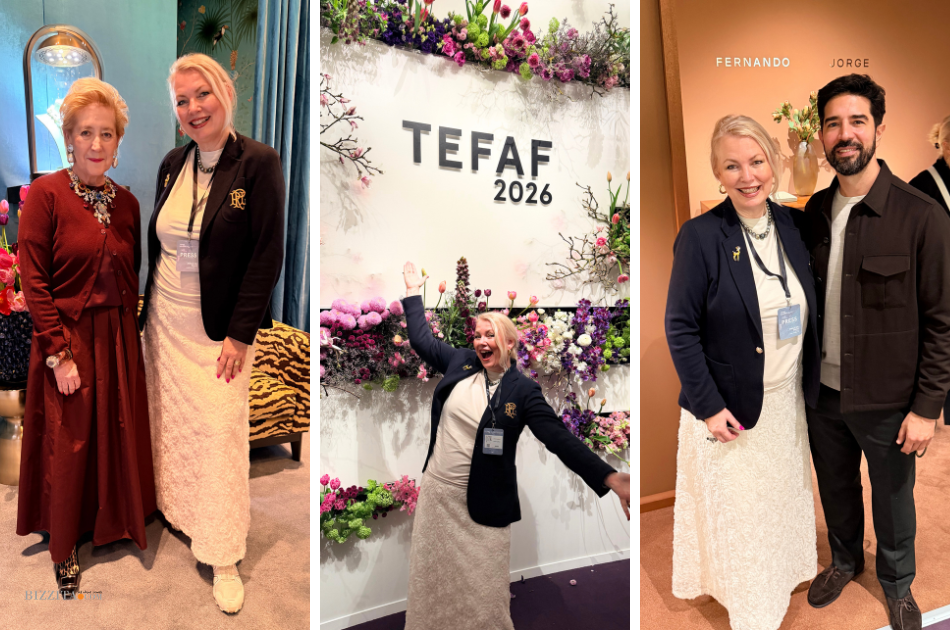
TEFAF’s own 2026 jewelry preview reflected that variety, including names such as Margot McKinney, Hemmerle, Buccellati, Otto Jakob, Cora Sheibani, Fernando Jorge, FORMS, Didier, A. Aardewerk and others.


Jewelry at TEFAF Maastricht 2026: what stood out to me
VKD Jewels and Langi Roma
One of my stops was VKD Jewels, the family-run business founded in 1969 and now led by the next generation, known for selecting exceptional antique and vintage pieces from the great jewelry houses. The stand is always worth a visit because of its sharp curation. The eye is trained. Nothing feels random. We enjoyed their very warm welcome!
I went there specifically to see Langi Roma's jewelry with my own eyes. I had been approached earlier to showcase the pieces on Bizzita, and I wanted to see whether the reality lived up to the promise.
It did...
The work was precise, intelligent, and beautifully resolved. There is something in it that balances the architectural with the natural, and that combination is not easy to achieve. It was one of those moments where seeing the pieces in person matters enormously. Jewelry can look lovely online. But presence, proportion, detail, and finish can only really be judged in real life.
At VKD, my heart was also stolen by a small Van Cleef & Arpels lion brooch with an injured eye and a tiny bandage. Utterly endearing. My veterinarian husband looked at me in that familiar way, which suggests he finds me affectionate, slightly ridiculous, and fully predictable in my weakness for animal jewelry.
I maintain that one can never have too much animal jewelry.

Van Cleef & Arpels
At Van Cleef & Arpels, we were given a tour through the Heritage collection. The Maison has long cultivated a distinctive poetic language, with signatures such as the Mystery Set, the Minaudière, the Zip necklace and Alhambra, and TEFAF has become an important place for showing such pieces in a more historical and collecting-oriented context.
What struck me again is that TEFAF is one of the few places where one can encounter these jewels not merely as luxury objects, but as part of the decorative arts.
Sure, there were important stones too. A necklace and bracelet set with extraordinary pigeon blood rubies was among the pieces shown to us, and several works had already sold in the opening days. The set was way too classic for my personal taste, but I appreciated the rubies' incredible quality, of course! Even while I was there, collectors were actively discussing pieces. One would have loved to know what was left with whom, but discretion is part of the air at TEFAF. So I moved on.
Otto Jakob
His work deserves a warning label of sorts, because anyone expecting conventional gemstone glamour is in for something else entirely. Otto Jakob is a self-taught artist-goldsmith who began making jewelry as a teenager and later studied painting with Georg Baselitz before devoting himself fully to jewelry. His work is available exclusively through his atelier and at TEFAF Maastricht and TEFAF New York.
What makes his booth so compelling is that the jewelry does not shout from afar. There is no bling here...but his jewelry pulls you in.
In the 2026 preview, TEFAF highlighted his Hemerocallis necklaces, in which carré diamonds and antique Indian polki diamonds are set into airy rhombohedral structures cast from daylily stalks, combined with engraved yellow-gold details and black enamel. It is a wonderful example of how he brings nature-casting, historical references, and contemporary design into one very personal language.
Seeing Otto’s jewelry with my husband was particularly interesting. On paper, or in a brochure, the work had not fully spoken to him. In person, it did. Suddenly, he could see the astonishing patience, the extraordinary detail, the quiet magic of it. Around us, people leaned closer and closer into the vitrines, as if the jewelry required a physical act of attention.

Which it does.
Cora Sheibani
Born in Zurich, trained in art history and gemmology, and known for combining unconventional gemstones and colours, she creates jewelry that is joyful, sculptural, and remarkably easy to wear. TEFAF described her pieces as defined by vibrant contrasts and personality, whether in her Fern Earrings or the 2025 Double Trouble Ring.
Meeting her was a delight. She shows self-confidence that comes from a solid background and a clear vision of her dreams.
There was freshness there, but indeed, also determination. She grew up around art and antiques and clearly knows where she comes from, yet her work does not feel derivative. It feels like someone finding her own visual language and trusting it. That is always attractive.
Hemmerle
Hemmerle remains one of the most compelling houses at TEFAF. Their work often feels as though it carries a past, even when newly created. Materials, textures, and forms come together in a way that suggests both memory and innovation. Collectors understand this. Hemmerle often uses artifacts as a basis for its designs, and tassels are a recurring theme for this Munich-based jewelry company. It's understated jewelry, so refined that perhaps only a connoisseur's eye can appreciate the incredible, elegant designs and materials this German jewelry brand uses.
And these are exactly the people who return for it.

FORMS
FORMS works with rarity and precision. Limited production, unusual gemstones, and refined construction define the brand. Their pieces feel light, but never simple. I remembered especially their earrings from a previous visit. Movement, color, and balance, all carefully considered.
The TEFAF 2026 preview included a bangle set with a 9.33-carat fancy deep brown-orange diamond and shakudo details, as well as a vivid pink spinel, ruby, and diamond ring. Both pieces show what FORMS does so well: lightness, precision, bold colour, and a fresh perspective on high jewelry design.
A. Aardewerk
A. Aardewerk represents something deeply rooted; a family business with a long history, their stand combines antique silver and jewelry in a way that feels both scholarly and inviting.
The dollhouse presentation drew a crowd. It was one of those moments where curiosity takes over, and people gather instinctively. I love these kinds of novelty displays, creating that moment of awe and childlike joy!
S.J. Phillips
S.J. Phillips has an impressive collection; there is no doubt about that. But what stayed with me here was something else. At fairs like TEFAF, I often observe how one is received before introductions are made. Before anyone knows who you are.
In most booths, there is a sense of openness. Here, that moment felt more distant. Perhaps simply timing. Fairs are human places too.
René Boivin
René Boivin, however, gave us quite the opposite experience.
The house, whose identity has long been associated with modernity, discretion, and avant-garde imagination, remains one of the great names of 20th-century jewelry.
At the stand, the welcome was kind and generous. My enthusiasm was met with enthusiasm, which is always a pleasure. Pieces were taken out, details were discussed, and the dark booth with its focused lights suited the jewelry beautifully.
I absolutely adored the parrot earrings, with their amethysts, rubies, and diamonds. Important jewels, certainly. High jewelry, unquestionably. But also joyful. Elegant, yes, but not stiff. Ready, one imagines, for queens, princesses, and women who do not need a title to feel entirely at ease in something magnificent.

Margot McKinney
And finally, Margot McKinney. The queen of the baroque pearl, if you ask me.
Margot McKinney is a fourth-generation Australian jewelry designer whose work draws inspiration from the coral reefs, rainforests, red earth and oceans of Australia, and whose pieces often feature Australian South Sea pearls, boulder opals and vivid coloured gems. She is known for taking years, even a decade, to assemble the right stones for a single jewel.
Her Bloem collier, presented at TEFAF 2026, was a highlight of the official jewelry preview: a floral necklace centered around exceptional tourmalines and twenty-seven large Australian South Sea baroque pearls, named after the Dutch word for flower.
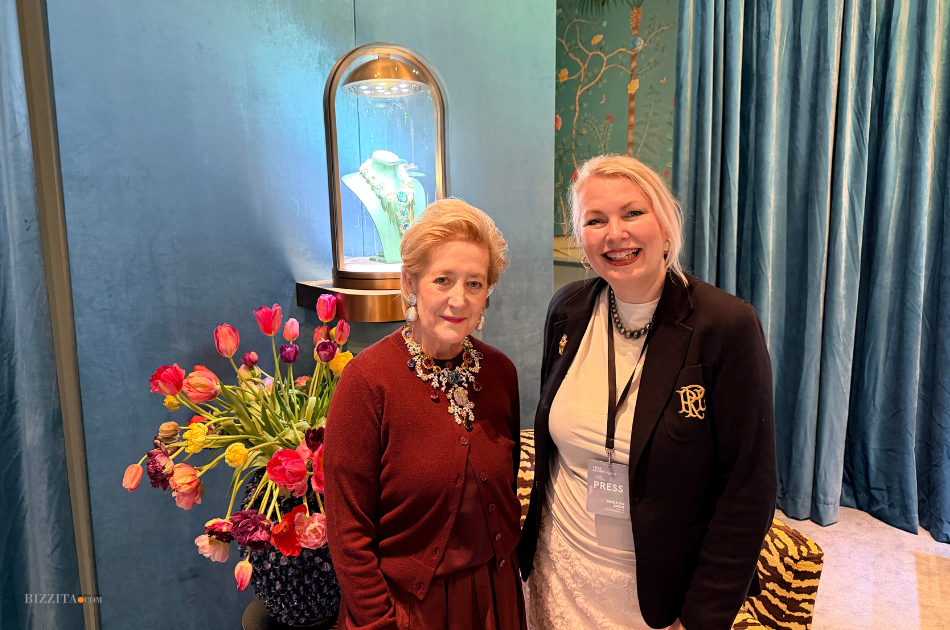
Seeing it in person, I was struck again by how little shyness exists in her work. These are not timid jewels. They are lush, bold, deliberate. And yet Margot herself is rather minute and modest in presence, which only makes the contrast more charming.
People often say that large jewelry suits “a certain kind of woman” or a certain body type. I do not believe that for a second.
Bold jewelry suits conviction. That is all.
And Margot McKinney’s pieces ask for exactly that.
Fernando Jorge
Fernando Jorge's disco earrings had caught my attention long before his debut this year at TEFAF. I just know they are absolutely spectacular, adorning playful light to the wearer's face. And I pictured how they would look on mine, but to see them in real life, is something else. Fernando Jorge told me he felt so happy and honored to be at this show.
Just by assocation alone, from a marketing perspective, showing your audience you exhibited here...it is everything. Fernando showed me around his beautiful collections and although he may come across as a little shy, I know what determination it takes to build a brand name like he did.

What Collectors Look for in Jewelry at TEFAF
Across conversations and observations, a few patterns emerge.
Collectors at this level look for:
- Provenance and history
- Rarity and uniqueness
- Craftsmanship and technique
- Emotional connection
- Cultural or artistic relevance
Jewelry here is not an impulse purchase. It is a considered purchase, many times prepared in advance and certainly many purchase conversations happen after the show, too.
Why Jewelry Brands Fight to Exhibit at TEFAF
Because TEFAF offers something few places can; context.
A jewel shown here is not isolated. It is part of a broader narrative of art, history and culture. And all that at the highest imaginable level and that association has value.
It builds trust and it attracts the right audience. It positions a brand within a framework of pure excellence. And, oh my, it creates moments of discovery that cannot be replicated online.
TEFAF is not where jewelry is simply sold.
It is where jewelry is understood.
Esther Ligthart is a jewelry industry expert, writer and founder of Bizzita.com, with over 30 years of experience in the international jewelry business.

© 2013 - 2025 Bizzita. All Rights Reserved
Legal Information | Copyright & Privacy Policy | Term & Conditions